Published 5 October 2026 · Product selection remains subject to the site and approved specification.
A fabric name is only the beginning of a parking-shade decision. Before choosing HDPE, PVC-coated polyester or a PVDF-finished membrane, decide what the covering needs to do at your site. Is the priority shade for an open parking row, rain coverage at an entrance, or a roof that meets a consultant’s written specification?
This guide turns those requirements into a practical selection process. For a material-by-material explanation, use our separate HDPE, PVC and PVDF comparison. Here, the focus is how to make a useful choice for your parking area.
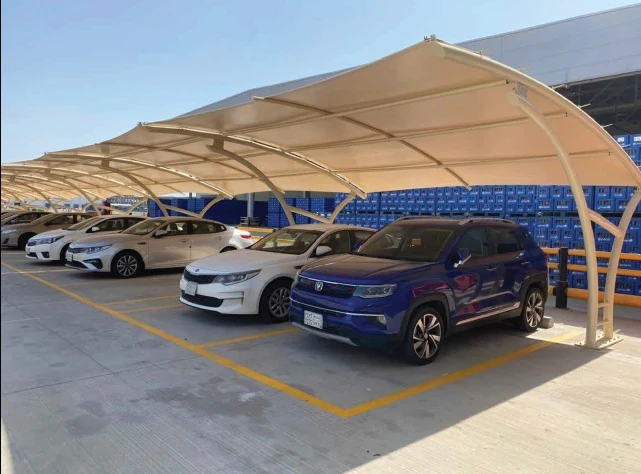
Start with the coverage you need
Write a short description of how the parking area is used. Staff parking, visitor bays and a drop-off point may have different priorities even on the same property. Decide which areas need shade and whether staying dry during rain is part of the brief.
- Open parking rows: discuss sun coverage, airflow and unobstructed vehicle movement.
- Entrances and pedestrian connections: explain whether continuous rain coverage matters and where water can discharge.
- Existing structures: identify whether you need a replacement covering or a change in the roof’s function.
- Specified work: send the consultant’s material and structural requirements before comparing alternatives.
Sun coverage depends on the layout as well as the fabric
A canopy’s outline does not show exactly where its shadow falls throughout the day. Review the parking orientation, the times when bays are used, roof projection and adjacent buildings. A material change alone cannot correct a layout that leaves the required area exposed.
Ask for the selected product’s solar-shading and UV information rather than a percentage attributed to every fabric of that type. Do not turn a fabric test into a promised temperature reduction inside a vehicle. Our cantilever parking-shade guide explains how coverage and support positions should be considered together.
Choose between ventilated shade and rain coverage
Conventional uncoated knitted HDPE allows water through and can be considered where an open, ventilated shade covering suits the brief. If rain coverage is required, specify it expressly. Coated HDPE products are a separate category with their own product data; the word HDPE does not settle the question.
PVC-coated polyester membranes can be reviewed for a coated-roof requirement. PVDF is a surface finish used on some membrane products, rather than a complete specification on its own. Identify the base fabric, coating and finish before comparing proposals.
For a rain-covering system, settle the roof shape, seams, edges and discharge routes with the design. Ask where runoff will go, especially beside doors, pedestrian paths and accessible bays. A product description does not replace those details.
Turn dust and maintenance into practical questions
For a site exposed to dust, ask how the covering will be reached for inspection and cleaning. Record nearby operations that could affect access or leave deposits on the roof. Maintenance should be possible without improvised access above parked vehicles.
Request the manufacturer’s cleaning instructions for the named fabric and surface finish. Confirm suitable equipment and products before cleaning. A finish described as easier to clean still needs an agreed maintenance approach; it should not be presented as maintenance-free.
At coastal sites, review the frame too
For work in Dammam or Khobar, explain the actual site exposure and any client requirements. Fabric selection and steel protection are separate decisions that need to fit the same structure. Review the connections, drainage and future inspection access alongside the proposed steel finish.
Our coastal planning guide covers the scope questions to raise. For an inland location such as Riyadh, assess the actual parking use and exposure just as carefully; the city name alone is not a design specification.
Wind and fire requirements must be checked for the system
Do not choose a heavier fabric as a shortcut to a wind rating. The covering, support arrangement, connections and foundations need to be reviewed through the project’s structural design. Send any required design criteria with your inquiry; a general article cannot supply a site-specific rating.
If fire performance is specified, request the current test documentation for the exact proposed product and confirm that it addresses the project requirement. A broad material name or the word “fire-rated” is not enough to establish suitability.
Before accepting a proposal
- Confirm the objective: solar shade, rain coverage or both, with the required area identified.
- Identify the product: manufacturer, product reference, fabric construction and finish.
- Review the design: coverage, vehicle access, columns, roof geometry and water discharge.
- Check the documents: relevant product data and any consultant requirements.
- Agree the scope: fabrication, installation, steel protection, maintenance information and exclusions.
If the frame already exists, send photographs of the covering, fixings and supports before selecting a replacement. See what to check before fabric replacement or repair.
Frequently asked questions
Should every Saudi parking area use the same fabric?
No. Start with the site’s coverage objective, layout, maintenance access and written requirements. Review the named product and complete structure against that brief.
Does PVDF automatically mean a better parking shade?
No. A surface finish alone does not establish suitability. The base membrane, construction, design and project requirements must also be identified.
Can I change from a permeable covering to rain coverage?
Ask for a review of the existing frame, fixings, geometry and drainage first. Do not assume a direct fabric swap is suitable when the roof function changes.
Ask for a site-specific quotation
Umbrella Tent & Shades is based in Dammam and provides car parking shade design, engineering, fabrication and installation across Saudi Arabia, with 20+ years of experience.
Tell us your project city and what needs covering. If you have a layout, drawing, photograph, dimensions or parking-bay count, send it with your inquiry. We’ll review the details and confirm what is needed for a quotation. These extra details are optional; you can start with a short description.
Use the quotation form. The form has no file upload, so drawings and photographs can be emailed to info@umbrellatentshades.com. We aim to respond within 24 hours.
Technical references
General material points were checked against GALE Commercial’s fabric guidance, its coated shade-fabric information and Serge Ferrari’s surface-finish guidance. These references do not identify the fabric in the photograph or imply a supplier relationship.