Published 12 October 2026 · Buyer planning guide
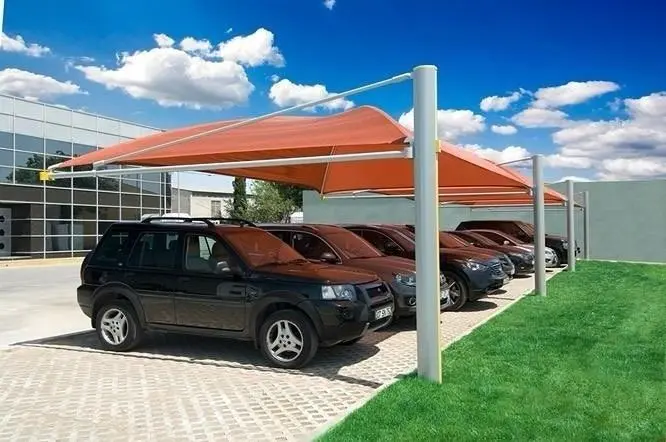
If a parking shade quotation says “waterproof”, ask what that promise covers. A material that resists water is only one part of the finished canopy. Panel joints, roof edges, the supporting shape and the route to the site's drainage all need to fit the agreed requirement.
This guide helps Saudi property owners and procurement teams define rain coverage before ordering. It complements our weather and material selection guide by focusing on the water-management scope.
Define the area that needs rain cover
Mark the required area on a parking layout: the vehicle bays, a passenger loading zone, an entrance or a pedestrian route. Ask whether the proposal covers just the roof footprint or a connection to another building. Open sides also matter; a roof alone should not be understood as an enclosed shelter against wind-driven rain.
For a hospital or workplace, identify routes that must stay usable during rain. For residential parking, note doors, neighbouring plots and existing drains near the proposed canopy. These details help establish where runoff can go without simply shifting the problem to another part of the site.
Ask for the named covering, not just a material category
Conventional knitted shade cloth allows water through. Manufacturers also offer coated products with different water performance, so “HDPE” alone does not identify rain protection. With PVC-coated or other specified membranes, request the manufacturer, product reference and current technical data. Our HDPE, PVC and PVDF guide explains the categories.
Then ask how seams, panel connections and perimeter details will be made. A fabric data sheet is not a blanket guarantee for every joint or the completed installation. Record any rain-performance commitment, its conditions and exclusions in the project proposal.
Follow the water from the roof to its destination
Ask the designer to identify intended runoff points on the drawing. For a tensile canopy, the approved geometry and tensioning arrangement must address water accumulation. A generic slope figure copied from another project is not a substitute for reviewing the actual membrane and supports.
Where gutters or downpipes are proposed, confirm their locations, discharge points and responsibility for connecting to the site drainage. Where water sheds directly from an edge, review what lies below it. Avoid assuming that a nearby drain has capacity or permission to receive the new discharge; that needs assessment by the responsible site team.
Separate canopy work from drainage and civil work
Before comparing prices, ask each supplier to mark these items as included, excluded or requiring review:
- Covering, seams, edge details and approved installation drawings.
- Any gutters, outlets, downpipes and supports.
- Connections to existing drainage, underground work and surface reinstatement.
- Coordination with adjacent buildings and the client's civil contractor.
- Handover information, inspection access and the agreed acceptance procedure.
This makes two quotations easier to compare. It also helps distinguish a canopy supply price from the cost of managing water across the site. Use our quotation checklist for the wider brief.
Plan inspection and future maintenance
Agree what drawings, product records and maintenance instructions will be handed over. Ask how the owner can safely inspect outlets and arrange cleaning under the selected product's instructions. If an existing membrane has sagging or standing water, arrange a qualified assessment; do not puncture, retension or replace it without reviewing the cause and supporting structure.
Changing an existing permeable shade to a less permeable covering needs a review of the frame, fixings, geometry and drainage. Our fabric replacement guide covers the initial condition check.
Prepare a clear rain-cover enquiry
Send your project city, layout, the area needing rain cover, photographs of surrounding levels and any drainage drawings or consultant requirements. Umbrella Tent & Shades serves shade projects across Saudi Arabia from Dammam. Start with the parking-shades service or request a quotation; email drawings to info@umbrellatentshades.com. For a quick response, message us on WhatsApp.
Common buyer questions
Does HDPE automatically mean waterproof?
No. Conventional knitted shade cloth is permeable, while coated products have their own specifications. Ask for the exact product and its stated water performance.
Are gutters included with every parking canopy?
No. Their need and scope depend on the approved design and discharge arrangement. Ask the proposal to state whether gutters, downpipes and site connections are included.
Can new fabric fix water pooling on an existing shade?
Not necessarily. The membrane condition, geometry, tension, fixings and frame need assessment before a remedy is proposed.
Technical reading: GALE Commercial fabric FAQs and Joint Research Centre guidance on tensile membrane structures, including its discussion of ponding. These are background references, not a claim that a particular product is supplied or that European guidance replaces the project's Saudi requirements.